
What Are the Best Outdoor Trampolines for Global Buyers?
Choosing the best outdoor trampolines for global buyers requires more than comparing prices, colors, or advertised bounce heights. A reliable evaluation must examine frame strength, enclosure design, weather resistance, replacement parts, installation instructions, and after-sales support. The U.S. Consumer Product Safety Commission’s trampoline injury data shows that emergency departments continue to treat tens of thousands of trampoline-related injuries annually. That figure makes safety engineering a buying requirement, not a decorative feature.
Market research also signals growing demand. Grand View Research has reported continued expansion in the global trampoline market, driven by residential recreation and family fitness. However, market growth does not prove that every product is dependable. Reports often combine indoor, outdoor, commercial, and recreational models. That limitation matters. Buyers should compare specifications carefully.
Dr. Michele LaBotz, a sports medicine specialist and contributor to American Academy of Pediatrics guidance, stated, “The best way to prevent trampoline-related injuries is to not use a trampoline.” Her warning deserves attention, even when families choose supervised use. The right product should include a strong galvanized-steel frame, UV-resistant padding, a secure safety net, and clear weight limits. ASTM F381 and ASTM F2225 standards can provide useful reference points, although certification claims still require verification.
No ranking is perfect.
This guide compares outdoor trampolines through a practical lens: safety features, climate durability, maintenance demands, installation quality, and long-term value. A lower-priced model may look attractive beside a premium competitor. Yet missing spare parts, weak anchors, or unclear warranty terms can create expensive problems later. Global buyers should consider local weather, shipping conditions, available service, and children’s age before making a final decision.
What Defines a High-Quality Outdoor Trampoline?
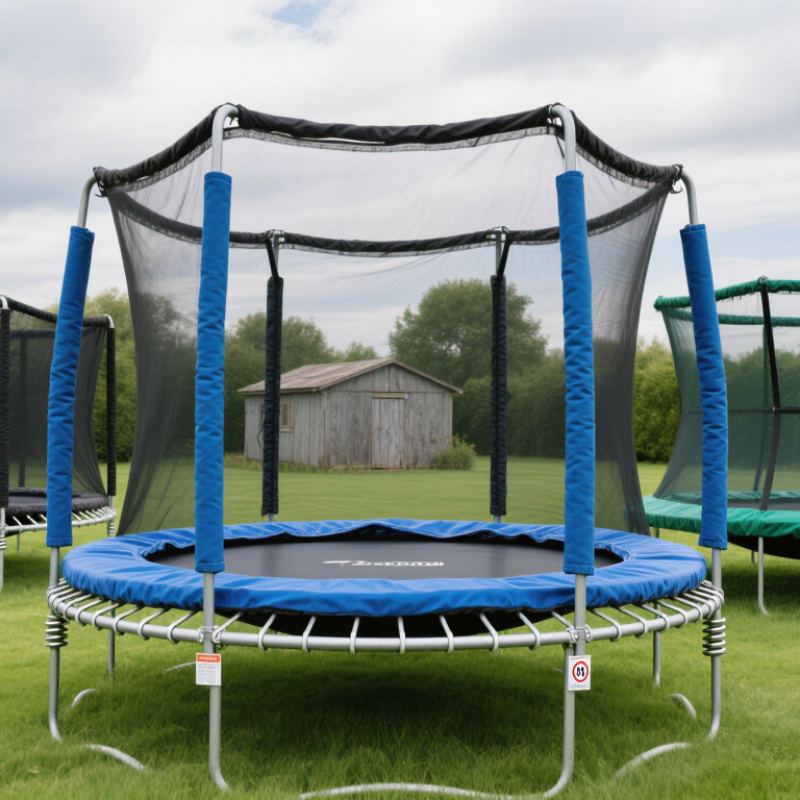
A high-quality outdoor trampoline begins with a frame that resists weather, movement, and careless assembly. Look for thick, galvanized steel with smoothly finished welds and stable, wide-set legs. In practical inspections, loose joints often reveal themselves before the jumping mat fails. That small detail matters. The mat should use tightly woven, UV-resistant material and strong, evenly spaced stitching. It should feel firm, not brittle, after prolonged sun exposure.
Safety also depends on the enclosure, padding, and connection points. A reliable enclosure uses durable mesh, secure poles, and a closure that stays shut during active use. Thick edge padding should cover springs and frame gaps without shifting under repeated impact. Check the anchor system too, especially in windy gardens or exposed coastal areas. Manufacturers may cite different testing standards, so global buyers should verify current local requirements independently. Certificates help, but they do not replace careful product inspection. Looks can mislead.
Good design includes maintenance access, clear instructions, and replacement parts that remain available. Measure the yard before ordering; a trampoline needs generous clearance from walls, branches, and hard surfaces. I once underestimated the importance of drainage beneath the frame, and damp ground created avoidable cleaning work. That mistake changed my checklist. Inspect bolts, net tension, padding, and rust every few weeks. Even excellent equipment can become unsafe when users ignore weather warnings or exceed the stated capacity.
What Are the Best Outdoor Trampolines for Global Buyers? - What Defines a High-Quality Outdoor Trampoline?
| Quality Dimension | Recommended Data or Benchmark | Why It Matters for Outdoor Buyers | What to Verify Before Purchase |
|---|---|---|---|
| Available Diameter | Common residential sizes range from approximately 2.4 to 4.9 m (8 to 16 ft). | A larger jumping area improves usable space, but it also requires more garden clearance and a stronger anchoring plan. | Confirm the assembled outside diameter, not only the advertised jumping-mat diameter, and measure the installation area first. |
| Frame Material | Preferred Hot-dip galvanized or corrosion-protected steel tubing with securely formed joints. | Outdoor frames are exposed to rain, humidity, soil splash and temperature changes. Corrosion protection helps preserve structural strength. | Check the coating method, tube dimensions, joint construction and whether replacement frame parts are available. |
| Frame Stability | A high-quality frame should include a wide base, multiple legs and positive locking connections; curved or reinforced legs can improve resistance to movement. | Jumping creates repeated vertical and lateral loads. A stable base reduces rocking and frame displacement. | Look for clear assembly instructions, locking pins or bolts, evenly distributed legs and compatible ground anchors. |
| Jumping Mat | UV-stabilized polypropylene fabric with tightly woven construction and reinforced perimeter stitching. | The mat must withstand repeated flexing, sunlight and moisture while maintaining its attachment points. | Check the fabric specification, stitching quality, attachment loops and the availability of a replacement mat in the correct size. |
| Spring System | Galvanized or otherwise corrosion-protected steel springs with consistent length and tension; spring count varies by model size. | Uniform springs support predictable bounce and distribute loads around the mat. | Do not compare spring count alone. Also verify spring length, wire diameter, attachment method and replacement availability. |
| Safety Enclosure | Fine-mesh netting, a securely attached top edge and a self-closing entrance with a reliable zipper or overlapping closure. | An enclosure helps reduce the risk of falling from the jumping surface, although it does not eliminate supervision requirements. | Ensure the net is attached to the frame or mat as designed, has no accessible gaps and remains tensioned after assembly. |
| Padding and Edge Protection | Thick, closed-cell foam padding covered by durable, UV-resistant and water-resistant material; padding should fully cover the frame and springs. | Users may land near the perimeter. Continuous padding reduces contact with hard metal components. | Check padding coverage, attachment straps, drainage, seam quality and whether the cover remains secure during use. |
| Wind Management | Use a location sheltered from strong prevailing winds and install ground anchors appropriate to the soil; never rely on the frame’s weight alone in exposed areas. | A trampoline can act like a sail during storms and may move or overturn even when not in use. | Review the manufacturer’s anchoring method, local wind exposure and severe-weather instructions. Disassemble or secure the unit during storms when required. |
| Weather Resistance | Outdoor-rated materials should provide resistance to UV exposure, rain and temperature variation; steel parts should have corrosion protection. | Weather resistance affects service life, appearance and the reliability of safety components. | Look for documented UV and corrosion claims, care instructions, drainage features and recommendations for seasonal storage. |
| Maximum User Policy | Essential One user at a time is the safest operating rule for most home trampolines, regardless of the platform size. | Multiple users can collide and create uneven loads, particularly when users have different weights or abilities. | Follow the product label and manual for the stated maximum user weight, age guidance and one-user operating requirement. |
| Load Information | Published maximum user weight commonly varies by design and size; there is no universal safe load value for all trampolines. | Overloading can increase stress on the mat, springs, frame and enclosure connections. | Choose a model with a clearly stated maximum user weight and never treat total household weight as a substitute for the listed limit. |
| Safety Testing | For applicable markets, buyers may look for conformity with relevant requirements such as EN 71-14 in Europe or ASTM F381 in the United States. | Recognized safety requirements address construction, labeling, warnings and use-related hazards. | Verify the exact standard edition, scope, test documentation and market applicability rather than relying only on a generic “tested” statement. |
| Assembly Quality | Clear multilingual instructions, labeled components, correct tools and a realistic two-person assembly process. | Incorrect assembly can compromise frame stability, spring tension, net attachment and padding coverage. | Confirm the manual includes diagrams, parts identification, tightening guidance, inspection steps and post-assembly checks. |
| Inspection and Maintenance | Inspect the mat, springs, padding, net, frame, fasteners and anchors before every use; replace damaged or stretched parts promptly. | Outdoor exposure and repeated jumping can cause wear that may not be visible from a distance. | Choose a design with accessible replacement parts and follow the inspection frequency stated in the manual. |
| Installation Clearance | Install on a level, firm surface with unobstructed space above and around the trampoline; avoid trees, fences, overhead cables and hard obstacles. | Clearance reduces collision risks and allows the enclosure and frame to function as intended. | Follow the product’s specified clearance distances and local site-safety guidance before installation. |
| Spare Parts and Support | Strong Advantage Replacement mats, springs, padding, nets, anchors and hardware should be identifiable and available. | Replaceable components extend product life and make maintenance safer than using improvised parts. | Confirm part numbers, compatibility by size and model, delivery coverage and the expected support period in your market. |
Data shown are practical quality benchmarks and common market ranges, not a specification for every trampoline. Always follow the product manual, local safety requirements and the manufacturer’s stated limits.
Related Posts
-

What is the Ultimate Outdoor Play for Kids and Families?
-
How to Create the Perfect Backyard Playground for Your Kids?
-

10 Essential Tips for Choosing the Best Vinyl Playsets for Your Kids?
-
Why Choose Backyard Swing Sets with Installation for Your Home?
-

China Best Outdoor Playground Equipment for Global Buyers?
-

Best Wooden Playsets in China for Global Buyers?