
What Are the Top Playground Sets for Home?
Choosing among playground sets for home is not simply a matter of picking the tallest tower or brightest slide. A strong set should match a child’s age, physical abilities, available space, and daily play habits. It should also fit the adults who will inspect, clean, and maintain it. In a small yard, a compact climbing dome may offer more useful movement than an oversized structure with unused features. In a larger garden, swings, a low climbing wall, and a shaded platform can create varied play without feeling crowded.
Dr. Joe Frost, a respected playground researcher, described playgrounds as “laboratories of childhood.” That idea remains practical. Children test balance on uneven steps, negotiate turns at the slide, and learn confidence from manageable challenges. Parents should examine materials, anchor points, fall zones, guardrails, and hardware before comparing prices. Wood can look warm and natural, while molded plastic may need less maintenance. Metal can be durable, but it may become hot in direct sunlight. Details matter.
The top playground sets for home are not always the most expensive. They are the ones that encourage active, imaginative play while making supervision realistic. Still, no product is perfect. A set may promise years of use, yet children can outgrow it sooner than expected. Another may look impressive online but feel cramped in person. This guide considers those limitations, along with safety, durability, installation, and value, so families can make a confident choice without ignoring the small uncertainties that real homes bring.
Understanding Home Playground Set Types and Their Main Features
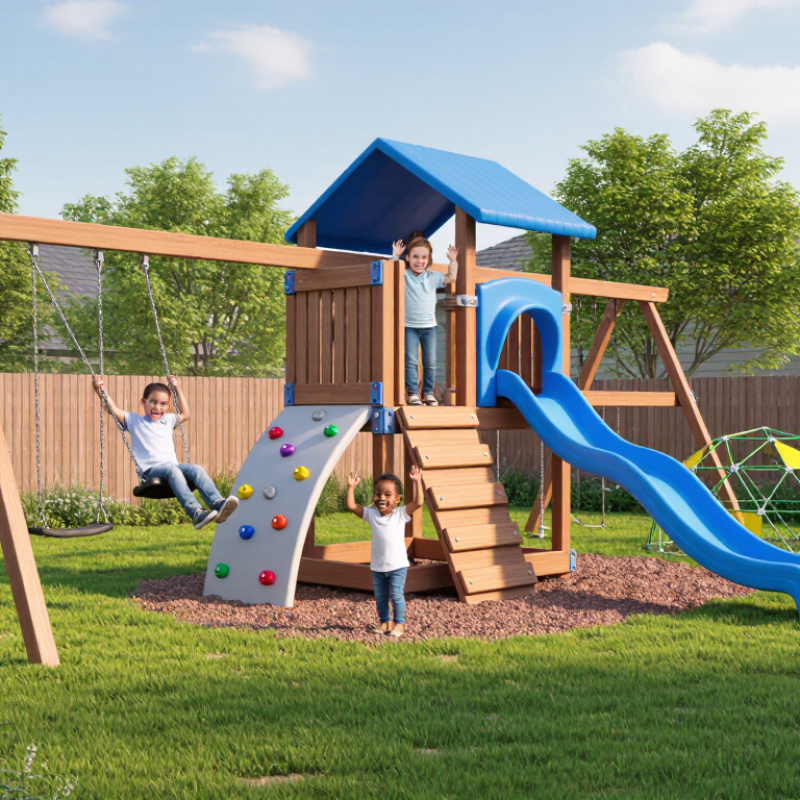
Home playground sets come in several useful types. Traditional swing sets suit families who want simple movement and easy supervision. They usually include two swings, a slide, and sometimes a small climbing ladder. Compact play towers fit smaller yards. They may combine a platform, short slide, and crawl tunnel. Larger modular sets add monkey bars, rope elements, playhouses, and multiple climbing routes. These features encourage balance, grip strength, coordination, and imaginative play. In my experience, children often return to climbing features longer than expected. However, bigger is not always better.
Tips: Measure the yard before choosing a set. Leave a clear fall zone around every climbing area. Check the recommended age range, platform height, weight limits, and surface materials. Grass looks soft, but it offers limited protection after repeated rain. Use properly installed impact-absorbing surfacing instead. Secure every anchor firmly. A level base matters more than many buyers expect.
Material choice also affects maintenance. Treated wood can feel warm and natural, but it needs regular inspection for cracks, splinters, and moisture damage. Metal frames are often durable, though exposed surfaces may become hot under direct sunlight. Plastic components are lighter and easier to clean, but they can fade or weaken over time. Reliable safety guidance supports frequent checks for loose bolts, sharp edges, worn ropes, and trapped fingers. I would not claim that one set suits every home. Children’s ages, available space, supervision habits, and local weather should shape the final decision. Some planning details are easy to overlook.
What Are the Top Playground Sets for Home? - Understanding Home Playground Set Types and Their Main Features
| Playground Set Type | Typical Recommended Age | Common Footprint | Main Activities | Typical Platform Height | Ideal Surface | Approximate Capacity | Key Advantages | Important Considerations |
|---|---|---|---|---|---|---|---|---|
| Toddler Climber Set | 18 months to 4 years | About 4 × 5 ft | Low climbing steps, short slide, crawl-through areas, steering wheel or activity panel | 1–3 ft | Level ground with a protective impact-absorbing surface | 1–3 children | Compact, low to the ground, and suitable for developing balance and coordination | Use only with close adult supervision; check that openings are too small for head entrapment. |
| Swing Set | 2–12 years, depending on the seat type | About 8 × 10 ft | Belt swings, bucket swing, trapeze bar, or glider | Usually 4–8 ft swing beam height | Deep, impact-absorbing material beneath and around the swing arc | 2–5 children | Provides active movement and can be expanded with different swing seats | Requires a generous fall zone; keep the swing path clear of walls, fences, trees, and other equipment. |
| Compact Slide and Climber | 2–8 years | About 5 × 7 ft | Climbing wall or ladder, platform, slide, and handgrips | 2–5 ft | Impact-absorbing ground cover around the slide exit and climbing area | 2–4 children | Offers climbing and sliding in a space-efficient layout | The slide exit should be unobstructed, and the structure should be anchored according to the instructions. |
| Combination Playset | 3–12 years | About 12 × 14 ft | Slide, climbing wall, ladder, swings, play deck, and activity panels | 4–7 ft | Level, well-drained ground with impact-absorbing surfacing | 4–8 children | Balances several types of play and can serve children of different ages | Needs substantial clearance, regular hardware checks, and careful supervision when younger children use higher areas. |
| Climbing Dome or Geodesic Climber | 5–12 years | About 8 × 8 ft | Climbing, hanging, traversing, and imaginative group play | 5–7 ft | Impact-absorbing surface covering the entire fall area | 3–6 children | Encourages upper-body strength, spatial awareness, and open-ended play | Check grip spacing, structural stability, and the fall height; climbing equipment may be unsuitable for toddlers. |
| Sandbox and Activity Station | 2–8 years | About 5 × 5 ft to 8 × 8 ft | Digging, scooping, building, sensory play, and table-based activities | Ground level | Clean, well-drained play sand or another approved loose-fill material | 2–5 children | Supports creative, sensory, and cooperative play with minimal fall risk | Use a fitted cover, remove debris regularly, and replace or maintain the fill as needed. |
| Nature-Inspired Play Structure | 3–12 years | About 10 × 12 ft | Logs, stepping elements, low platforms, climbing features, and balance paths | 1–5 ft | Stable, level ground with suitable impact-absorbing surfacing | 3–7 children | Integrates balance, exploration, imaginative play, and varied movement | Natural materials require inspection for rot, splinters, sharp edges, loose parts, and weather damage. |
| Accessible Playground Set | 2–12 years, based on individual abilities | About 10 × 14 ft or larger | Transfer platforms, accessible ramps, ground-level activities, wide pathways, and adaptive swings | Varies by feature | Firm, stable, slip-resistant, and accessible surfacing | 3–8 children | Promotes inclusive play and easier access for children with different mobility needs | Verify pathway widths, transfer spaces, surfacing, and equipment suitability for the intended users. |
| Water and Mud Play Station | 2–8 years | About 4 × 6 ft | Water channels, scoops, basins, sand mixing, and outdoor sensory activities | Ground level | Slip-resistant, well-drained surface | 2–5 children | Encourages sensory exploration, cooperation, and creative experimentation | Supervise continuously around water, prevent standing water, and clean components frequently. |
Related Posts
-
Top 10 Outdoor Playground Equipment Suppliers Worldwide?
-
What Are the Best Outdoor Play Sets in 2026?
-
2026 Top Backyard Play Ideas for Fun and Engaging Outdoor Activities?
-
2026 Top Outdoor Playsets for Kids What to Look For?
-
2026 How to Choose the Best Vinyl Swingsets for Your Backyard?
-
What is a Backyard Play Set and Why is it Important for Kids?