Top 10 Backyard Play Equipment Ideas for Kids?

Choosing the right backyard play equipment can turn a plain lawn into an active, inviting space. Children may see a climbing frame; parents see balance, coordination, confidence, and possible risks. This guide explores ten practical ideas, from compact sand tables to adventure swings, with attention to age, space, durability, and supervision.

Stuart Brown, MD, founder of the National Institute for Play, says, “Nothing lights up the brain like play.” His observation supports a simple principle: good backyard play should encourage movement, imagination, and social interaction. A low balance beam can become a bridge over imaginary lava. A shaded reading nook can become a spaceship before lunch.

Safety still matters. Measure the available area before buying equipment. Leave clear space around swings and slides. Check weight limits, rounded edges, secure anchors, and fall-protection surfaces. Inspect bolts after heavy rain or strong winds. Follow the manufacturer’s instructions and relevant local safety guidance. No design fits every family. A large play tower may overwhelm a small yard, while a simple water table may offer more daily use. Even careful planning can miss something. Children grow quickly, and equipment that suits a four-year-old may frustrate an eight-year-old. The ideas ahead are starting points, not perfect answers. Consider your child’s abilities, your climate, and how often adults can supervise. The best backyard play area is not necessarily the biggest. It is the one children return to, explore safely, and help make their own.
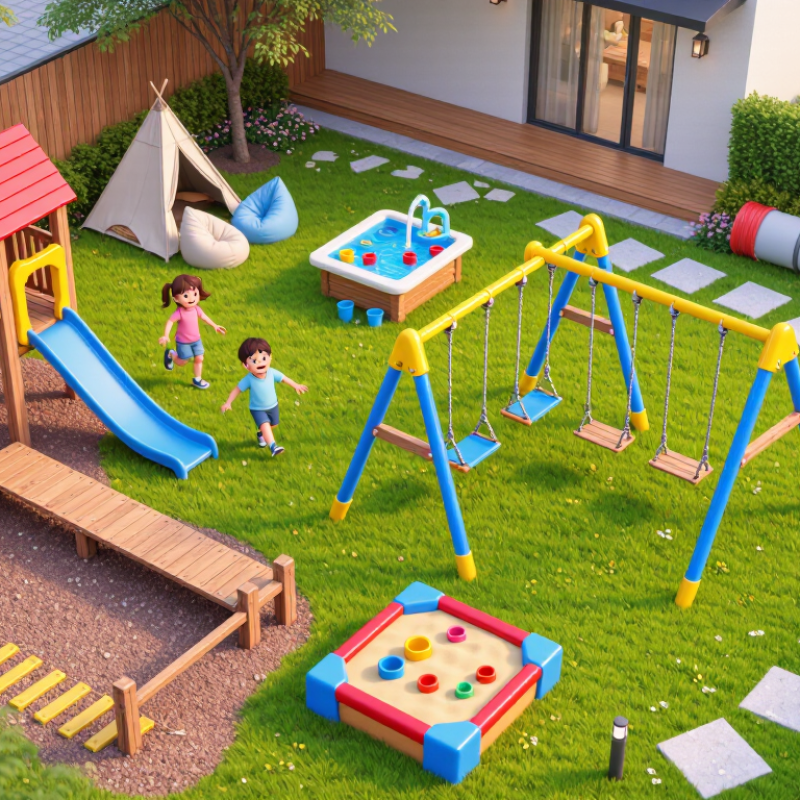
Top 10 Backyard Play Equipment Ideas for Kids?

Understanding Backyard Play Equipment and Its Benefits

Backyard play equipment is more than colorful entertainment. It can support strength, balance, coordination, confidence, and daily movement. The World Health Organization’s 2020 physical activity guidelines recommend at least 60 minutes of moderate-to-vigorous activity daily for children aged 5–17. A climbing wall, swing set, slide, balance beam, sandbox, stepping stones, playhouse, rope ladder, mini obstacle course, and open play area can help make that movement enjoyable.

Safety shapes these benefits. The U.S. Consumer Product Safety Commission reports that playground equipment causes about 200,000 emergency-department-treated injuries among children each year. Falls remain a major concern. Use impact-absorbing surfacing, secure anchors, rounded edges, and age-appropriate equipment. Keep swings away from fences and walls. Adult supervision still matters, especially near climbing features. A backyard set is not automatically healthy. Children may avoid it if the steps feel difficult, the surface gets hot, or the layout offers only one activity.

Tips: Check bolts, ropes, and surfaces every week. Measure the fall zone before installation. Rotate loose items, such as balls, cones, and chalk, to refresh interest. Observe how children actually play, not how the equipment looks in a catalogue. The perfect setup is unrealistic. A simple balance path may create more movement than an expensive structure. Reflect, adjust, and invite children to help redesign the space safely.

Choosing Equipment Based on Age, Space, and Safety Needs

Top 10 Backyard Play Equipment Ideas for Kids?

Age should guide every equipment choice. Toddlers aged two to four need low, simple challenges. A sandbox, water table, small playhouse, balance beam, and wide stepping stones work well. Keep platforms close to the ground. Avoid gaps that could trap fingers, hands, or feet. Preschoolers may enjoy a short slide and a belt swing with secure back support. Older children can use a climbing dome, monkey bars, and a sturdy seesaw. They need challenge, but not unnecessary height.

Space changes the safest layout. Measure the yard before buying anything. Leave a clear fall zone around swings, slides, and climbing equipment. Soft ground, such as engineered wood fiber or approved rubber surfacing, can reduce injury severity. Grass may look soft, but it often becomes hard after dry weather. Check bolts, ropes, edges, and wood surfaces every week.

I once underestimated how quickly loose hardware could appear after heavy rain. That mistake changed my inspection routine. Safety instructions still matter.

Supervision should match the child’s age and ability. A four-year-old may copy an older sibling without understanding the risk. Place active equipment where adults can see it easily. Shade helps, too. Hot metal and wet platforms can cause burns or slips. Choose equipment that fits today’s skills, not only future growth. Children develop differently. A cautious child may need extra time.

Exploring Ten Popular Backyard Play Equipment Ideas

Top 10 Backyard Play Equipment Ideas for Kids?

Exploring ten popular backyard play equipment ideas can make outdoor time more active and imaginative. A compact swing set supports coordination, while a low slide offers controlled movement. Climbing domes build grip strength and confidence. A sandbox encourages digging, pouring, and cooperative play. Balance beams develop body awareness, although children may need frequent supervision. Playhouses create space for pretend games. Water tables add sensory play on hot afternoons. Small obstacle courses combine stepping stones, tunnels, and crawling paths. A shade-covered reading nook offers calmer outdoor time. Trampolines provide vigorous exercise, but they require strict age guidance, enclosure checks, and limited occupancy.

Safety should shape every choice. The U.S. Consumer Product Safety Commission reported about 200,000 emergency-department playground injuries annually in older national estimates. Falls remain a major concern. The American Academy of Pediatrics also identifies falls as the leading cause of playground injuries. These figures cover public and home settings, so backyard equipment should not be treated as automatically safer. Install impact-absorbing surfacing, check bolts weekly, and keep equipment away from fences, pools, and tree branches. Follow the equipment’s age and height recommendations carefully.

A practical home inspection takes only a few minutes. I look for sharp edges, loose ropes, standing water, and hot metal surfaces. Still, no checklist is perfect. Children use equipment in unexpected ways. The National Program for Playground Safety recommends age-appropriate design, active supervision, and safe surfacing. An adult nearby can notice fatigue, crowded platforms, or unsafe climbing before a small mistake becomes an injury.

Planning Installation, Supervision, and Routine Maintenance

Top 10 Backyard Play Equipment Ideas for Kids

A safe backyard begins with planning, not purchasing. Choose equipment that matches children’s ages, abilities, and available space. Measure fall zones carefully around swings, slides, climbing walls, and balance beams.

The U.S. Consumer Product Safety Commission reports about 200,000 playground injuries receive emergency treatment annually. Falls cause roughly 79% of these injuries (CPSC, Public Playground Safety Handbook). That figure changes how I position every structure.

Install equipment on level ground, away from fences, trees, pools, and hard surfaces. Use impact-absorbing surfacing that meets ASTM F1292 performance requirements. Anchor posts securely, then check every connection before children play. I once overlooked a slightly loose cap. Small oversights matter. Adults should supervise actively, staying close enough to intervene. Phones belong elsewhere. The World Health Organization’s Global Status Report on Physical Activity 2022 also supports regular active play, but activity must remain age-appropriate.

Tips:

Walk around the equipment before each use. Look for exposed bolts, sharp edges, cracked plastic, unstable posts, and wet surfacing. Test swings and ladders with gentle pressure. Keep a simple weekly checklist, and record repairs with dates. Monthly, inspect anchors and drainage after heavy rain. Seasonal reviews are useful, though I sometimes postpone them. That is exactly why a calendar reminder helps. Replace damaged parts promptly, not after an accident.

Comparing Costs, Materials, and Long-Term Usability

A useful backyard setup can include ten ideas: swings, a slide, climbing dome, monkey bars, sandbox, balance beam, tire swing, playhouse, water table, and trampoline. Costs vary widely. Basic wooden equipment often costs $300–$900, while metal systems may exceed $1,500. Prices depend on height, hardware, installation, and ground preparation.

Materials affect service life. Pressure-treated wood feels warm but needs sealing and frequent checks for cracks. Powder-coated steel handles heavy use, yet rust can appear around bolts. Recycled plastic resists rot and splinters, although it may fade in strong sunlight. A sandbox with a fitted cover can remain useful for years. Adjustable swings and climbing features usually serve children longer than fixed toddler equipment. That matters.

Safety is not optional. The U.S. Consumer Product Safety Commission reports that more than 200,000 children receive emergency treatment for playground-related injuries each year. Its public playground safety guidance recommends protective surfacing, guardrails, and regular hardware inspections. ASTM F1487 also provides widely used performance specifications for residential-style play structures. Parents should measure fall zones with a tape measure, not guess. I have found that low-cost sets often become expensive after replacement anchors, fading panels, and repairs. A cheaper choice can still work, but only with disciplined maintenance. Children also outgrow equipment faster than expected.

Top 10 Backyard Play Equipment Ideas: Cost vs. Expected Usable Life

This comparison uses typical U.S. purchase prices for unbranded equipment and estimated usable lifespans with regular maintenance. Costs exclude installation, ground preparation, delivery, and replacement parts.

How to read the chart: Bars show estimated initial cost in U.S. dollars, while the line shows expected usable life in years. Metal and well-maintained wood equipment generally offer longer service life, while plastic items tend to have lower upfront costs but shorter replacement cycles.