China Top Backyard Swing Sets With Installation Suppliers
Choosing China’s top backyard swing sets with installation suppliers requires more than comparing colorful catalogs and low quotations. A reliable supplier should combine tested materials, accurate drawings, trained installers, and responsive after-sales support. The best partners explain timber treatment, metal coatings, swing-seat spacing, anchoring depth, and fall-zone requirements in clear language. They also provide installation instructions, inspection records, and replacement-part policies before payment.
Dr. Joe L. Frost, a respected playground researcher and professor emeritus, described play as “the work of childhood.” That idea matters here. A backyard swing set is not merely outdoor furniture. It becomes a daily environment where children climb, balance, negotiate turns, and test confidence. Suppliers should therefore design around age groups, surface impact protection, weather exposure, and adult supervision. A strong installation team checks level ground, concrete curing, bolt tightness, and movement after assembly. Small details matter.
This guide examines China-based backyard swing sets with installation suppliers through an E-E-A-T lens: practical experience, technical competence, credible documentation, and dependable communication. It considers factory quality control, customization, shipping coordination, installation coverage, and warranty handling. Buyers should still verify current local safety requirements independently. Standards and site conditions vary. No supplier is perfect. Even an attractive quotation can hide unclear installation boundaries or delayed spare parts. Careful questions often reveal more than polished photographs. The right supplier should welcome those questions and provide evidence, not vague promises.
China Backyard Swing Set Standards: ASTM F1148, EN 71, and GB/T 27689
Choosing a China-made backyard swing set requires more than checking steel thickness. Safety begins with the correct standard and controlled installation.
ASTM F1148 covers home playground equipment in the United States. It addresses structural strength, openings, entrapment risks, sharp edges, and user safety.
EN 71 focuses on toy safety, including materials, flammability, and mechanical hazards. However, EN 71 may not cover every outdoor swing application. Buyers should confirm the product category and destination market with an independent testing body.
GB/T 27689 provides China’s requirements for children’s playground equipment. It supports checks on design, materials, durability, and protective details. A reliable installation supplier should provide test reports, material records, anchoring drawings, and clear maintenance instructions.
Ask how the frame is fixed to level ground. Ask how concrete foundations are protected from water.
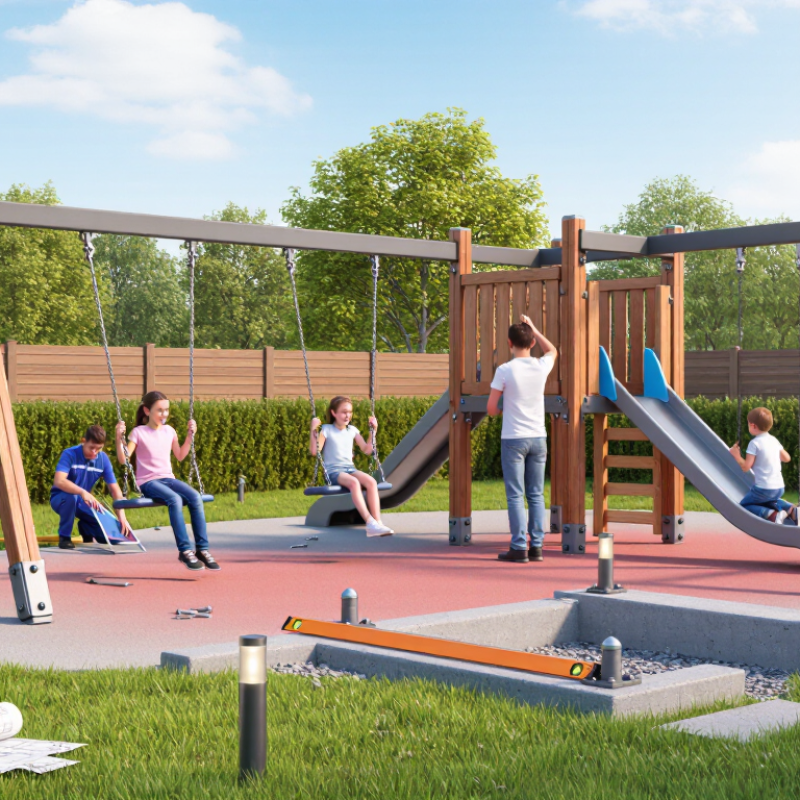
During site checks, installers should measure swing clearance, inspect welds, and confirm that bolts cannot loosen during movement. Impact-absorbing surfacing also deserves attention, even when the frame passes factory testing.
Standards do not replace local risk assessment. A certificate may look complete, yet installation errors can still create hazards. This is where many projects need more careful review. Suppliers should document torque checks, foundation curing, and the final handover inspection. Photos help, but they do not replace physical testing.
Safety Design Data: 6-Foot Fall Zones and Twice-the-Swing-Height Clearance
China’s top backyard swing set suppliers should treat safety data as a design requirement, not a marketing phrase.
The U.S. Consumer Product Safety Commission’s Public Playground Safety Handbook recommends a protective surface extending at least six feet around play equipment. For swings, the front and rear use zones should extend twice the swing’s height, measured from the pivot point to the ground.
This measurement matters during installation. A six-foot fall zone needs level, impact-absorbing surfacing, such as engineered wood fiber or tested rubber material. ASTM F1292 evaluates surfacing by critical fall height, helping installers match material depth with equipment height.
Supplier drawings should show post positions, swing travel, surfacing boundaries, and nearby fences or walls. Experienced installation teams measure from the installed frame, not only from factory diagrams.
The rule sounds simple.
In practice, it is easy to miss. A sloped yard, thick edging, or a swing mounted slightly higher can reduce usable clearance. I would also question any supplier that lists “six feet” without identifying the measurement point and surfacing test. Installation records, material certificates, anchor details, and site photographs improve reliability. One imperfect assumption remains: children do not swing in perfectly straight lines. Allowing extra side clearance, beyond the minimum guidance, is a practical decision for safer backyard use.
Material and Load Testing: Steel, Wood, HDPE, and 150 kg Seat Ratings
China’s backyard swing set suppliers should treat material testing as a safety decision, not a catalog feature. The U.S. Consumer Product Safety Commission reports roughly 200,000 playground-related emergency department visits each year. Falls remain a major contributor. That figure makes installation quality as important as the swing frame.
Steel frames need weld inspection, coating checks, and corrosion testing, especially near coastal homes. Wood requires moisture control, structural grading, and checks for splitting around bolt holes. HDPE seats resist moisture and splinters, but ultraviolet exposure can reduce long-term strength. The ASTM F1487 standard provides widely used playground safety guidance, while EN 1176 supports comparable equipment and impact-surface evaluations. Suppliers should provide current laboratory records, not only internal claims.
A 150 kg seat rating should reflect a tested seat, chain system, beam, and anchors. It should not mean one brief pull test. Ask for static loading, repeated-cycle testing, and anchorage verification. The installation team should confirm level footing, correct bolt torque, and fully cured concrete before use. In practice, a 150 kg adult load can create higher forces during swinging. That detail is often missed. Independent testing improves trust, but reports still need matching model numbers and production batches. I would also recheck wood movement after the first wet season; even careful specifications can overlook local weather.
Supplier Evaluation: Factory Audits, Certifications, Warranties, and Lead Times
When evaluating Chinese backyard swing set suppliers, begin with a factory audit, not attractive catalog photos. Inspect welding areas, timber treatment, coating lines, and hardware storage. Ask for recent production records and photographs from the same facility. A clean showroom proves little. An independent audit can reveal weak inventory controls or rushed assembly practices.
Verify certifications against the exact swing set model and destination market. Check testing scope, certificate dates, material references, and the issuing laboratory. Generic certificates are not enough. Installation suppliers should provide trained crews, clear site requirements, and illustrated fixing instructions. Ask how they manage uneven ground, concrete depth, and fall-zone clearance. These details affect safety more than polished sales language.
Warranty terms deserve careful reading. Confirm coverage for frames, fasteners, wood, coatings, and labor separately. Also ask who pays for replacement parts and local installation visits. Lead times should include production, inspection, packing, shipping, and installation scheduling. Request a written timeline with inspection points and delay procedures. My own review mistake was trusting a promised delivery date without checking component availability. That assumption created pressure later. A stronger evaluation compares the supplier’s documents, factory evidence, communication speed, and after-sales response in practical detail.