
What Are the Top Backyard Play Equipment Options?
Choosing backyard play equipment is no longer about filling an empty lawn. It is about creating safe, varied movement opportunities for children. Market analyses from Grand View Research and Fortune Business Insights report continued growth in outdoor play equipment, supported by rising interest in home recreation and active childhoods. Yet market growth does not guarantee a good purchase. A bright plastic tower can still offer limited challenge.
The American Academy of Pediatrics connects play with physical, social, and cognitive development. Its clinical report, written by child-development specialist Kenneth R. Ginsburg, states, “Play is not frivolous: it enhances brain structure and function, and promotes executive function.” That principle should guide every backyard play decision. Swings can build rhythm and balance. Slides add controlled risk and excitement. Climbing frames develop grip strength and coordination. Sand, water, and loose natural materials encourage imagination without fixed rules.
Safety needs equal attention. The U.S. Consumer Product Safety Commission’s Public Playground Safety Handbook recommends protective surfacing, proper fall zones, secure anchoring, and regular inspections. The World Health Organization also recommends daily physical activity for children, but equipment alone cannot create healthy habits. Children need space, supervision, and freedom to choose.
There is no universal winner.
A compact yard may suit a modular climbing dome, sandbox, and low slide. A larger space could support swings, a climbing wall, and balance elements. Families should measure the ground, inspect materials, and consider age changes over time. I would not treat one “best” list as final. Children grow quickly, and the most exciting equipment today may become boring next year.
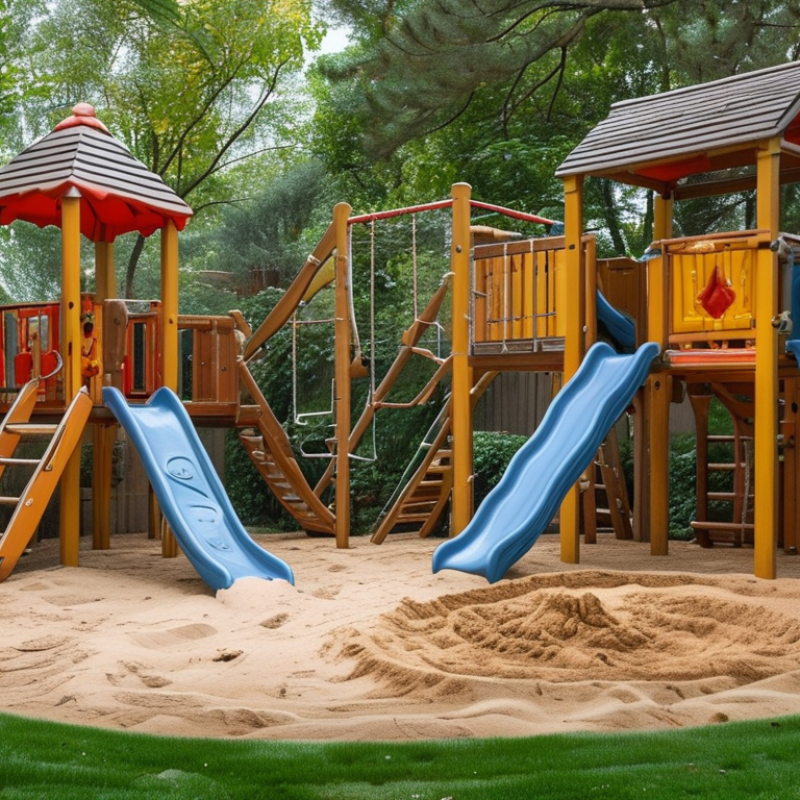
Types of Backyard Play Equipment and Their Main Features
What Are the Top Backyard Play Equipment Options?
Backyard play equipment works best when each type supports a different movement skill. Swing sets develop rhythm, balance, and leg strength through repeated motion. Choose seats with secure hand grips and enough spacing between moving parts. Slides add excitement and coordination, while climbing frames build upper-body strength and problem-solving skills. A playhouse encourages imaginative play, although it may receive less use during very hot weather.
Balance beams, stepping stones, and low climbing walls create quieter challenges. They also help children practise body control without constant adult direction. The U.S. Consumer Product Safety Commission reports about 200,000 playground-related emergency department injuries among children under 14 each year. Falls account for roughly three quarters of those injuries in its playground injury surveillance data. This figure mainly reflects public playgrounds, but it remains a useful safety benchmark for home equipment. ASTM F1148 also provides a recognised safety framework for residential play structures. No layout is perfect. Supervision still matters.
Tips: Measure the available space before buying. Leave clear zones around swings and slide exits. Install impact-absorbing surfacing, not bare soil or concrete. Check bolts, ropes, anchors, and cracked plastic every month. Select equipment for the child’s age and ability, rather than choosing the largest structure. A lower frame may look less impressive, but it can offer safer, more independent play. Reconsider the layout after watching how children actually move through it.
What Are the Top Backyard Play Equipment Options? - Types of Backyard Play Equipment and Their Main Features
| Equipment Type | Typical Age Range | Main Features | Primary Benefits | Recommended Space | Common Materials | Key Safety Considerations | Maintenance Level |
|---|---|---|---|---|---|---|---|
| Swing Set | 2–12 years | One or more swings, supportive seats, and optional accessories such as a trapeze bar or glider | Builds leg strength, balance, coordination, and controlled movement | About 18–24 ft long and 12–16 ft wide, including clearance | Pressure-treated wood, powder-coated steel, plastic seats, and synthetic swing chains | Use a shock-absorbing surface; maintain clear space around the swing arc; check anchors and hardware regularly | Medium |
| Climbing Dome | 5–12 years | Geometric climbing frame with multiple hand and footholds for traversing and climbing | Develops grip strength, spatial awareness, balance, and problem-solving skills | Approximately 12–18 ft in diameter, depending on structure height | Galvanized or powder-coated steel tubing | Install on a resilient surface; supervise younger children; inspect joints, welds, and anchoring points | Low to medium |
| Playhouse | 2–8 years | Enclosed or semi-enclosed play space with windows, doors, and imaginative-play features | Encourages pretend play, communication, creativity, and independent activities | Typically 8–12 ft wide and 6–10 ft deep, plus access space | Weather-resistant wood, molded plastic, or composite panels | Provide ventilation; avoid sharp edges and pinch points; secure the structure against tipping or strong wind | Medium |
| Slide | 2–10 years | Straight, wavy, or spiral sliding surface with a ladder, steps, or platform | Supports gross-motor development, confidence, balance, and turn-taking | Allow at least 6–12 ft of unobstructed space in front of the exit | UV-resistant plastic, stainless steel, or coated metal | Check surface temperature in direct sunlight; use guardrails and a soft landing area; keep the exit clear | Low |
| Sandbox | 2–8 years | Contained play area for digging, molding, pouring, and building with loose-fill material | Improves fine-motor control, sensory exploration, creativity, and early construction skills | A compact unit may need 6–10 ft of usable width and surrounding walking space | Wood, recycled plastic, composite boards, and washed play sand | Use a fitted cover; remove debris and animal waste; choose clean play sand and provide shade where possible | Medium to high |
| Trampoline | 6 years and older | Flexible jumping mat, frame, springs or elastic bands, and optional safety enclosure | Provides vigorous physical activity and develops balance and body control | A 10–14 ft model requires a larger clear zone around and above the frame | Galvanized steel frame, woven polypropylene mat, and padded protective covers | Use one jumper at a time; install a properly secured enclosure; place on level ground away from trees and structures | High |
| Balance Beam | 3–10 years | Low, raised, or stepping balance elements arranged in a straight or varied path | Strengthens balance, posture, coordination, and confidence in movement | Usually needs 8–16 ft of length and a clear fall zone on both sides | Sealed wood, molded plastic, rubber-coated surfaces, or metal supports | Keep the beam low for younger children; eliminate sharp edges; use impact-absorbing ground below raised sections | Low |
| Water Play Table | 2–6 years | Raised basin with channels, cups, funnels, scoops, and removable accessories | Encourages sensory learning, hand-eye coordination, cause-and-effect exploration, and cooperative play | About 4–8 ft of space, preferably near a water source and suitable drainage area | Molded plastic, stainless-steel components, and non-toxic accessory materials | Provide constant supervision; empty and clean the basin after use; control slippery surfaces and standing water | Medium |
Related Posts
-
Best Home Outdoor Playground Options for Kids Worldwide?
-
2026 Top Backyard Play Ideas for Fun and Engaging Outdoor Activities?
-
2026 Top Outdoor Playsets for Kids What to Look For?
-
2026 How to Choose the Best Vinyl Swingsets for Your Backyard?
-
What is a Backyard Play Set and Why is it Important for Kids?
-
Top 10 Outdoor Playsets for Kids to Enjoy All Year Round?