How to Choose the Best Wooden Swingsets?
Choosing the best wooden swingsets starts with more than comparing prices or picking the largest frame. The right set should fit your yard, the children who will use it, and the time you can give to upkeep. A sunny patch of lawn, a low branch overhead, or a narrow gate can change what works.
Wood matters. Cedar and redwood are often chosen for their natural resistance to decay, while treated pine may offer a lower-cost option. Yet species alone cannot tell you whether a set is sturdy. Check beam dimensions, fasteners, swing-hanger design, weight limits, and the manufacturer’s installation instructions. Look for clear information about materials and warranty terms, not just polished photos. Details count.
Measure the play area before ordering, including room for swings to move and children to climb down safely. Consider age-appropriate features, anchoring, and a surface that can soften falls. Then compare assembly needs and seasonal care: wood may need cleaning, sealing, or periodic checks for splinters and loose bolts. These chores are easy to overlook. Start here.
There is no single best choice for every family. A compact frame may suit a small yard better than an elaborate tower, even if it looks less exciting online. This guide explains how to weigh safety, construction, space, durability, and value, so you can choose wooden swingsets with realistic expectations. Some trade-offs remain, and that is worth admitting before you buy.
Define Users and Capacity: Check the Set Against ASTM F1148
When choosing a wooden swingset, count who will use it now and who may join later.
ASTM F1148 is a safety and performance specification for residential playground equipment, but it does not replace the set’s own capacity instructions. Check the manual and labels for the maximum number of users, weight limits for each component, and age recommendations.
A wide platform can still feel crowded.
Count simultaneous users, not just seats.
A child climbing the ladder may share space with someone on the deck, while swinging children need clear room to move. Picture your yard on a busy afternoon: two children waiting, one climbing, and a swing moving nearby.
That distinction is easy to miss.
Capacity labels can be frustratingly vague, so ask the seller or manufacturer for written clarification if the limits are unclear.
Also check that the assembled set matches its instructions. Firm, level ground, secure anchoring, and the required clear space around moving equipment all affect safe use. Look for documentation stating that the model conforms to ASTM F1148, then confirm that the specific configuration and accessories are covered.
A cautious capacity estimate may leave a seat unused. That is usually better than squeezing in one more child.
Compare Wood Species, Treatment, and Warranties for Outdoor Use
When comparing wooden swingsets, look beyond color and price. Cedar is naturally resistant to decay and feels lighter to handle, but softer boards can dent under repeated impact. Redwood is durable where available, though its cost and local supply vary. Pressure-treated pine is often more affordable; check that the treatment is intended for outdoor residential structures, and follow its care instructions. Ask what species the frame actually uses, since rails and accessories may use different wood.
Treatment matters most where water lingers. Inspect the feet, ladder joints, and underside of platforms for sealed end grain, drainage gaps, and clear instructions on resealing. Keep the structure several inches above wet soil when the design allows. Use corrosion-resistant fasteners suited to outdoor exposure, especially near treated lumber. A small detail, but important. No finish makes wood maintenance-free; sunlight and seasonal moisture can still cause checking, fading, or rough spots. Sand splinters promptly, and recheck bolts after the first weeks of use.
Read the warranty before buying. Separate coverage for structural rot, insect damage, hardware, and finish; these terms may differ. Note the required maintenance, proof of purchase, and exclusions for ground contact or weather damage. A long warranty sounds reassuring, but narrow exclusions can matter more. It is easy to focus too much on the number of years. Compare the actual covered parts, and keep the care records somewhere you can find them.
Measure Swing Clearance: CPSC Recommends 2× Pivot-Height Zones
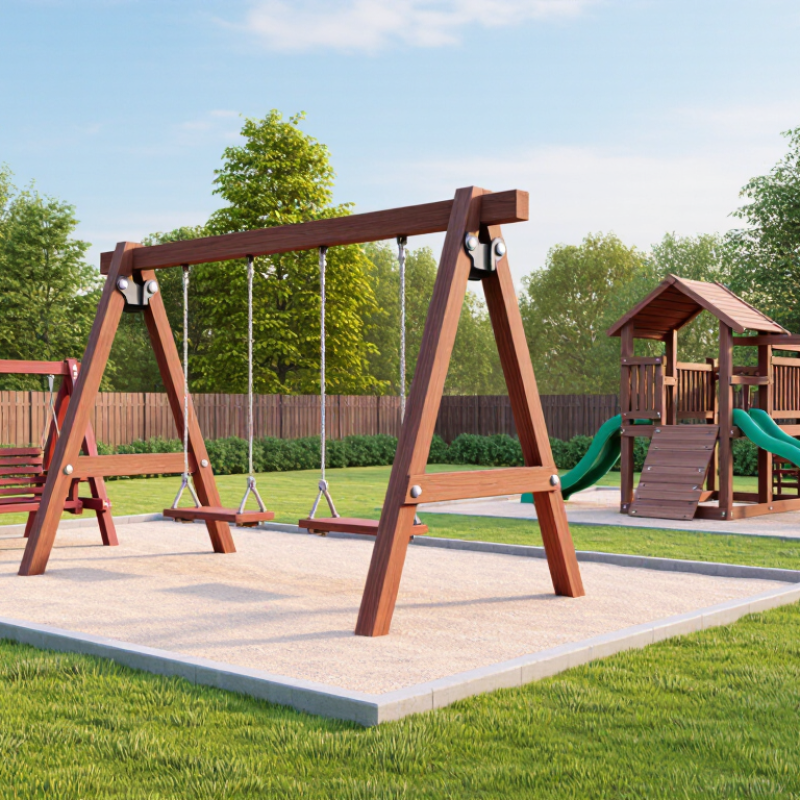
A wooden swingset needs more than a sturdy frame; it needs clear space for every swing arc. For a conventional swing, CPSC guidance recommends a use zone extending twice the pivot height in front of and behind the swing. Measure from the ground directly below the pivot point to the protective surface. If that height is 7 feet, keep about 14 feet clear in both directions. No guessing.
A tape measure makes this easier than judging the space by eye. Mark the front and rear boundaries, then check for fences, tree trunks, walls, and hard edging within the swing path. The area beneath the swing also needs suitable impact-absorbing surfacing; bare soil can shift or become compacted. Check the swing’s installation instructions, too, since its design may call for additional spacing. I have seen small yard features look harmless until a swing reaches its full arc. Measure again after installation, especially if the ground slopes or the frame sits on uneven soil. Clearances reduce collision risks, but they do not replace active supervision or regular checks for loose hardware.
Plan Fall Surfacing: CPSC Recommends 9 in. for Equipment up to 8 ft
When comparing wooden swingsets, look beyond the frame and check the fall surface. The U.S. Consumer Product Safety Commission recommends 9 inches of loose-fill surfacing for equipment up to 8 feet high. Measure the highest point a child could fall from, not just the swing seat. Nine inches is a useful planning target, not a promise of safety. Materials perform differently, and packed or wet fill may cushion less effectively.
Extend surfacing across the entire play area, including the space where a moving swing travels. Grass and thin mats can hide hard soil underneath. Check the depth regularly, especially below swings and at ladder exits, where children land repeatedly. Loose material shifts. Rake it back into thin spots, and add more when the measured depth falls short. Keep the area clear of roots, stones, and exposed edging. A careful check takes only a few minutes, though it is easy to skip when the yard looks fine. For a new installation, confirm the surfacing material’s guidance and the equipment’s fall height before settling on a final depth.
Check Anchors, Hardware, and Maintenance Access Before Buying
How to Choose the Best Wooden Swingsets?
A wooden swingset should feel steady before anyone climbs aboard. Check whether the design includes anchors, and confirm they suit your soil and installation surface. Loose, sandy ground may need a different approach from firm soil. Follow the installation instructions rather than assuming longer stakes will solve every problem. Ask what is included. Anchors can be easy to overlook.
Inspect the hardware closely. Bolts should sit flush, connections should feel secure, and exposed metal should be suited to outdoor use. Look for accessible fasteners, replacement parts, and clear instructions for tightening them. Give moving joints extra attention; they take repeated strain. Small details matter. A quick glance at a product photo cannot tell you how easy a bolt is to reach after assembly, so check diagrams or ask the seller.
Maintenance access deserves a place on your checklist. Can you reach the legs, underside of the platform, and swing connections without moving the whole structure? Look for areas where water might collect against the wood, and plan to inspect those spots regularly. Leave room around the set for safe checks and repairs. It is tempting to focus on size and appearance, but I would reconsider that instinct: a beautiful structure is less practical if routine tightening becomes awkward.
How to Choose the Best Wooden Swingset
How to use this chart: These illustrative 1–5 ratings show suggested inspection emphasis, not measured product test results. Before buying, check that the set includes suitable anchors and secure, corrosion-resistant hardware, and that key areas are accessible for routine inspection, tightening, and wood care.