
Why Choose Outdoor Play Sets for Schools and Daycares?
Outdoor play sets can turn an ordinary schoolyard or daycare space into a place where children climb, balance, imagine, and play together. A low climbing wall, sturdy steps, and a slide can invite movement while giving children chances to practice coordination and confidence. The benefits are not automatic, though. Equipment must suit children’s ages, abilities, and the space available.
For schools and daycares, choosing outdoor play sets is also a practical decision. Staff need clear sightlines, accessible entry points, and enough room for children to move without crowding. Materials should be designed for outdoor use, and the equipment should come with reliable installation and maintenance guidance. These details may seem small. They matter during a busy afternoon.
Play is not always neat. A child may hesitate at the ladder, while another invents a new game beside it. Adults can support exploration without turning every moment into a lesson. At the same time, regular checks for loose parts, worn surfaces, and debris help keep play areas in good condition. No single set works for every group. The right choice depends on children’s needs, supervision routines, budget, and available space. Those factors deserve honest attention before a purchase is made.
What Are Outdoor Play Sets for Schools and Daycares?
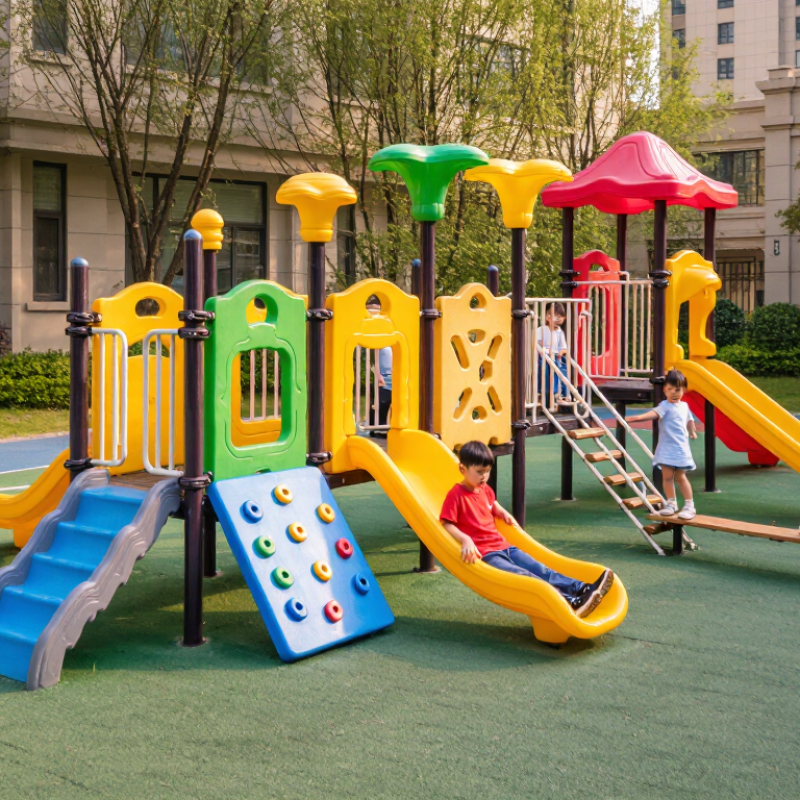
Outdoor play sets for schools and daycares are purpose-built activity areas for children’s movement, exploration, and social play. They may include platforms, slides, climbing walls, balance beams, tunnels, swings, and sensory panels. Some designs combine several activities within one connected structure. Others use separate pieces, leaving open space for running and supervised games. The best choice depends on children’s ages, abilities, available space, and daily routines.
In practice, teachers use these sets for more than physical exercise. A child can climb, pause on a platform, and decide how to descend. Another child may practice turn-taking near the swing or invent a game around a tunnel. Educators should check fall zones, handrails, surfacing, pinch points, and visibility before children enter. They also need regular inspections for loose fasteners, worn surfaces, standing water, and sharp edges. Accessible routes and varied challenge levels help more children participate without forcing the same activity.
No play set is perfect for every group. A tall climber may excite older children but overwhelm younger learners. A quiet sensory feature might look minor, yet it can support children who avoid noisy play. From an educator’s viewpoint, observing actual use matters more than trusting a product description. Children may ignore a popular feature and gather beside a simple step instead. That small surprise should shape future planning, maintenance, and equipment changes.
| Evaluation Dimension | Typical Data or Planning Range | Value for Schools | Value for Daycares |
|---|---|---|---|
| Primary Purpose | Active play Skill development | Supports structured physical education, recess, social interaction, and age-appropriate motor-skill development. | Creates a predictable outdoor routine for climbing, balancing, sliding, imaginative play, and supervised exploration. |
| Recommended Age Group | Common configurations serve children approximately 2–5 years, 5–12 years, or mixed-age groups. | Separate age zones can help elementary schools reduce conflicts between younger and older children. | Toddler and preschool areas should use equipment designed specifically for the children’s developmental stage. |
| Core Play Components | Platforms, slides, climbers, ramps, bridges, balance elements, panels, and ground-level activities. | Multiple activity types allow several children to play at the same time and support varied lesson objectives. | Ground-level panels and low-height activities provide accessible options for children who are not ready for elevated equipment. |
| Approximate Use Capacity | Often planned for about 10–30 children per play zone, depending on the design and site layout. | Larger, multi-activity layouts can help accommodate class rotations, recess groups, and different play preferences. | Smaller modules can support close supervision and manageable group sizes during outdoor activities. |
| Fall-Height Planning | Elevated play components commonly range from low ground-level features to approximately 6 feet, depending on age and design. | Equipment should be selected with the site’s required protective surfacing depth and fall-zone dimensions in mind. | Lower platforms and shorter access routes are generally more suitable for toddlers and younger preschool children. |
| Safety and Compliance Considerations | In the United States, commercial playground planning commonly references ASTM F1487 and applicable CPSC public-playground guidance. Accessibility may involve ADA requirements. | Helps facility managers coordinate equipment selection, inspections, accessible routes, supervision policies, and local building requirements. | Encourages age separation, controlled access, frequent inspections, and supervision practices appropriate for younger children. |
| Protective Surfacing | Engineered wood fiber, poured-in-place rubber, rubber tiles, and other tested loose-fill or unitary surfaces may be used. | The surface should be selected according to the equipment’s critical fall height, drainage needs, accessibility goals, and maintenance plan. | A stable, impact-attenuating surface can improve comfort and reduce trip hazards when properly installed and maintained. |
| Space Requirements | The total area includes the equipment footprint, use zones, circulation paths, access routes, and supervision sightlines. | A larger site can accommodate separate age zones, group activities, accessible circulation, and queuing space. | A compact layout with clear visibility can make daily supervision easier in smaller outdoor areas. |
| Physical Development Benefits | Activities can develop balance, coordination, agility, strength, spatial awareness, and gross-motor control. | Provides opportunities for active recess and movement-based learning beyond the classroom. | Supports early movement experiences through climbing, crawling, stepping, sliding, and balancing. |
| Social and Cognitive Benefits | Cooperative play areas can encourage communication, turn-taking, problem-solving, role play, and decision-making. | Multi-user equipment can support peer interaction and inclusive group play across different activity levels. | Pretend-play panels and shared activities can support language development, confidence, and early social skills. |
| Durability and Maintenance | Commercial outdoor equipment is generally designed for frequent use, but all materials require routine inspection and care. | A documented inspection schedule can help identify loose hardware, worn surfaces, damaged components, drainage problems, and vandalism. | Daily visual checks and prompt repairs are especially important because younger children may be less able to recognize hazards. |
| Weather and Site Factors | Sun exposure, rain, freezing temperatures, drainage, wind, soil conditions, and local climate affect material selection and usability. | Shade, drainage, and seasonal maintenance planning can increase the number of safe and comfortable outdoor-use days. | Shade structures, cool-touch considerations, and weather-appropriate scheduling can improve comfort for younger children. |
| Accessibility and Inclusion | Inclusive designs may include transfer platforms, ramps, accessible surfacing, ground-level activities, and varied challenge levels. | Supports participation by children with different physical, sensory, and developmental abilities when the entire route is planned accessibly. | Offers flexible play choices so children can participate at different developmental levels without relying only on elevated equipment. |
| Best-Fit Design Approach | Modular systems can be configured for available space, age range, capacity, accessibility goals, and budget. | A multi-zone design is often practical for serving different grades, activity preferences, and scheduled group sizes. | A lower-scale design with excellent visibility, simple circulation, and age-appropriate challenges is often the most practical choice. |
Planning note: The figures and ranges above are general industry planning references, not a substitute for a site-specific design review. Final equipment selection, protective surfacing, installation, accessibility, inspection, and use requirements should be checked against current local regulations and applicable safety standards.
Related Posts
-
How to Choose Outdoor Play Equipment for Your Business?
-
Top 10 Outdoor Playground Equipment Suppliers Worldwide
-
What Are the 2026 Best Vinyl Playground Sets?
-
Top 10 Outdoor Playground Equipment Suppliers Worldwide?
-
What Are the Best Outdoor Play Sets in 2026?
-

Top 10 Discount Outdoor Playsets for Global Buyers?