Choosing the right wooden playset outdoors involves more than comparing slides, swings, and price tags. It requires evidence, careful measurements, and a realistic view of family use. The U.S. Consumer Product Safety Commission reports roughly 200,000 playground-related injuries treated in emergency departments each year. Falls account for most reported cases, according to CPSC’s National Electronic Injury Surveillance System data. These figures cover playgrounds broadly, not only residential wooden playsets. Still, they show why platform height, protective surfacing, guardrails, and swing clearance deserve close attention.
A reliable buying decision should also reference ASTM F1148, the Standard Consumer Safety Performance Specification for Residential Play Equipment. Check whether the manufacturer explains material grades, load limits, anchoring methods, and replacement-part availability. The U.S. Forest Service Wood Handbook notes that wood performance depends on moisture exposure, construction details, and maintenance. Cedar may resist decay naturally, while treated pine can offer strength and value. Neither option is maintenance-free. Inspect splinters, loose bolts, cracked boards, and standing water before children play. Small details matter.
When comparing wooden playsets outdoor, match the design to your yard and your children’s abilities. Measure overhead branches, fall zones, gates, and nearby fences with a tape measure. Consider whether adults can reach every connection during inspection. No checklist is perfect. Product labels may be incomplete, and online reviews can exaggerate both praise and criticism. A safer choice combines recognized standards, transparent instructions, durable construction, and practical supervision. The best playset is not necessarily the largest one. It is the structure your family can install correctly, inspect regularly, and use confidently.
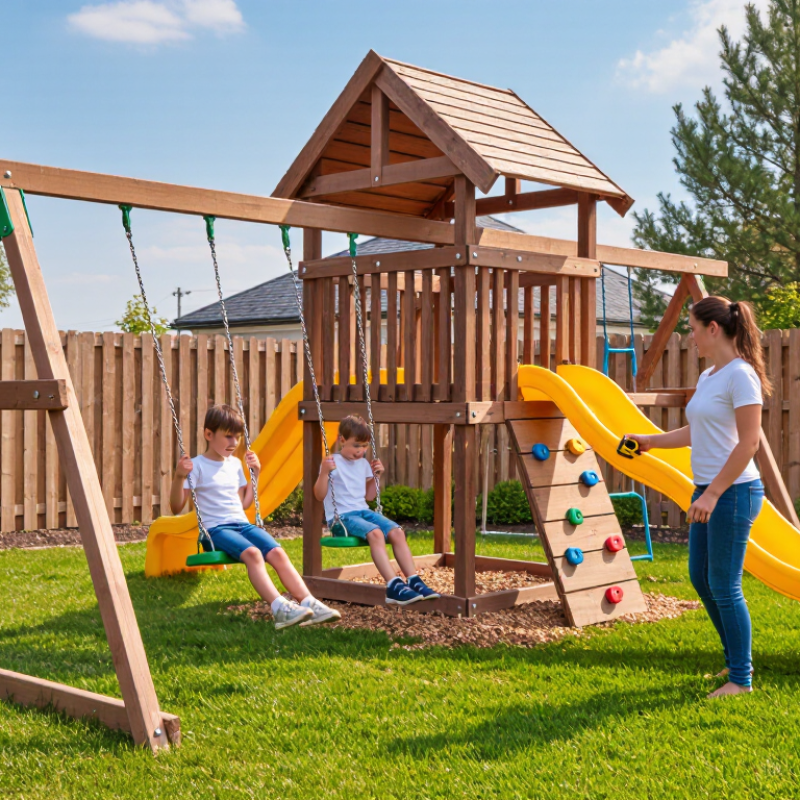
Understanding the main types helps families choose a playset that fits their space and children. Basic swing sets suit smaller yards and younger children. They usually include two swings, a small slide, and a climbing ladder. A tower or fort playset adds a raised platform, roof, slide, and imaginative play area. It needs more room and a deeper safety zone around the structure.
Modular wooden playsets offer more flexibility. Families can add monkey bars, climbing walls, or extra slides as children grow. Compact combination sets balance several activities in limited spaces. I have found that larger playsets can look exciting, but they may dominate a small yard. That choice deserves a second thought. Check the recommended age range, platform height, ladder spacing, and weight limits. Pressure-treated wood, smooth edges, sturdy anchors, and rust-resistant hardware also matter. Regular inspections can reveal loose bolts, splinters, or soft timber before they become hazards.
Tips: Measure the yard before shopping. Leave clear space around swings and slides. Place the set on level ground with impact-absorbing surfacing. Watch children during early use, even when the structure seems secure. A smaller set may be the wiser choice if maintenance time is limited. Recheck bolts after installation and after severe weather. Safety labels are useful, but careful observation remains essential.
How to Choose the Best Outdoor Wooden Playsets
Choosing an outdoor wooden playset starts with your yard, not the catalog. Measure the level area, then mark the swing paths and climbing zones with string. Leave clear space around slides, ladders, and platforms. Grass may look soft, but it can become hard after dry weather. A suitable impact-absorbing surface is important.
I once underestimated how quickly children move between features. That mistake changed how I judge playsets. Toddlers usually need low steps, short slides, handrails, and enclosed platforms. Older children may enjoy taller decks, climbing walls, fire poles, and challenging ladders. Check age, height, and weight guidance carefully. Choose features your child can use now, with some room to develop skills. Too many difficult elements can create frustration instead of active play.
Tips: Sketch the yard first. Measure twice. Check that doors and windows remain accessible. Look for rounded edges, strong joints, smooth sanding, and weather-resistant wood. Read the installation and maintenance instructions before buying. Inspect bolts, boards, and anchors regularly, especially after storms. Ask whether your child can reach every handhold safely. I sometimes focus too much on exciting features; quiet details often matter more. A shaded platform, comfortable spacing, and a clear view from the kitchen may improve daily use.
| Playset Configuration | Typical Footprint | Recommended Child Age | Suggested Yard Size | Typical Capacity | Useful Features | Space and Safety Considerations | Best Fit |
|---|---|---|---|---|---|---|---|
| Compact Toddler Playhouse | Approx. 1.8 × 1.8 m (6 × 6 ft) |
18 months–4 years | At least 5 × 5 m (16 × 16 ft) of usable level space |
2–3 children | Low platform, short steps, crawl-through opening, ground-level play area, small slide under approximately 1.2 m (4 ft) | Use age-appropriate barriers and handholds. Avoid elevated openings that could allow a small child to fall or become trapped. | Small yards and young children |
| Basic Platform and Slide Set | Approx. 2.4 × 2.4 m (8 × 8 ft) |
3–6 years | At least 6 × 6 m (20 × 20 ft) of usable level space |
3–5 children | Raised deck, ladder or steps, enclosed sides, slide, steering wheel, telescope-style accessory | Provide impact-absorbing surfacing beneath and around the equipment. Keep the slide exit clear of fences, trees, walls, and other play components. | First independent playset |
| Platform with Single Swing Beam | Approx. 3.0 × 3.0 m (10 × 10 ft) |
4–8 years | At least 7 × 9 m (23 × 30 ft) of usable level space |
4–6 children | One or two belt seats, climbing ladder, platform, slide, protective roof or canopy | Swings require a larger front-and-back clearance than stationary equipment. A common planning rule is approximately twice the height of the swing beam in the direction of travel. | Growing families with moderate space |
| Multi-Activity Wooden Set | Approx. 3.6 × 3.6 m (12 × 12 ft) |
5–10 years | At least 8 × 10 m (26 × 33 ft) of usable level space |
5–8 children | Two swings, climbing wall, ladder, elevated fort, slide, sandbox or picnic table | Separate moving equipment from fixed structures. Maintain an unobstructed protective surfacing zone around elevated platforms, climbing areas, and slide exits. | Active children and shared play |
| Fort with Climbing Wall | Approx. 3.0 × 4.2 m (10 × 14 ft) |
5–12 years | At least 8 × 10 m (26 × 33 ft) of usable level space |
4–7 children | Higher deck, climbing wall, cargo net, fire-pole-style exit, monkey bars, enclosed fort space | Higher platforms need secure guardrails and properly designed openings. Climbing elements should have impact-absorbing surfacing and adequate fall clearance. | Older children seeking challenge |
| Large Swing-and-Fort System | Approx. 4.2 × 4.8 m (14 × 16 ft) |
5–12 years | At least 10 × 12 m (33 × 40 ft) of usable level space |
6–10 children | Three-position swing beam, dual slides, climbing wall, fort, sandbox, trapeze bar or hanging accessories | Measure the full use zone, not just the timber frame. Allow additional room for swing arcs, slide exits, maintenance access, and nearby landscaping. | Large yards and multiple children |
| Modular Adaptable Playset | Approx. 2.4 × 3.0 m initially; expandable to 4.2 × 4.8 m |
3–12 years, depending on modules | At least 7 × 9 m initially; larger after expansion |
3–8 children | Replaceable accessories, adjustable layout, add-on swing beam, climbing panel, slide, picnic table, storage area | Confirm that each future module has sufficient clearance before purchasing. Do not add accessories unless the structure is designed and rated for them. | Flexible long-term use |
Choosing an outdoor wooden playset starts with wood quality, not appearance. The USDA Forest Products Laboratory’s Wood Handbook explains that decay risk rises when wood remains near 20% moisture content or higher. Look for pressure-treated or naturally durable timber, sealed end grain, and straight boards without deep cracks. Freshly cut ends absorb rain quickly. They deserve extra protection.
Construction details often reveal more than polished photographs. Bolts should pass through solid wood, with rounded edges and covered hardware. Joints need minimal movement after children climb, swing, and jump. The U.S. Consumer Product Safety Commission recommends protective surfacing beneath equipment, including about nine inches of loose-fill material for equipment up to seven feet high. A strong frame still needs safer landing space. Check the actual fall zones.
Weather resistance depends on drainage, ventilation, and maintenance. The USDA handbook describes wood as a moisture-responsive material; repeated wetting and drying can cause swelling, shrinking, and loose connections. Choose sloped roofs, raised posts, and gaps that let water escape. Inspect after harsh rain. I would not rely on stain alone. It can hide early damage. That judgment can be wrong, especially in coastal climates. ASTM F1148, the residential playground equipment safety standard, is useful for checking design expectations, but it does not replace regular hands-on inspections. Run a hand over every rail. Feel matters.
Choosing an outdoor wooden playset begins with safety standards, not appearance. The U.S. Consumer Product Safety Commission reports about 200,000 playground-related injuries each year requiring emergency treatment. For residential equipment, check whether the design follows ASTM F1148 guidance and includes clear age recommendations. Standards help, but they do not replace careful installation.
Stability deserves a hands-on inspection. Push each tower, swing beam, and ladder before children use it. The structure should not sway, lift, or twist on level ground. Secure posts with suitable anchors, and keep protective surfacing across the full fall zone. A loose bolt can become a serious hazard. My earlier inspections focused too much on visible cracks; hidden movement was easier to miss.
Maintenance needs a written routine. Inspect bolts, brackets, ropes, and swing connections monthly. Look for splinters, soft wood, rust, standing water, and faded protective coatings. The CPSC recommends regular inspections and prompt repair of damaged playground components. After heavy rain, recheck the ground around anchors because soil can loosen. Wood may look sound while rot develops underneath. ASTM guidance is useful, but local weather and installation quality still demand judgment. No checklist is perfect.
Checking safety standards, stability, and maintenance needs starts with the protective surface beneath the playset. The chart shows minimum loose-fill surfacing depths commonly referenced in the U.S. Consumer Product Safety Commission public playground safety guidance.
How to use this information: Choose a playset with a compliant protective surface, verify that the structure remains stable on level ground, and inspect wood, fasteners, joints, and surfacing regularly. Shredded rubber requires a minimum depth of 6 inches, while wood chips, engineered wood fiber, sand, and pea gravel commonly require 9 inches for comparable fall protection.
The lowest price rarely shows the full cost. A wooden playset may need delivery, ground preparation, assembly, sealing, and yearly inspections. I once focused too heavily on the purchase price. Later, I discovered that uneven soil increased installation time and expense.
Measure the play area carefully, including swing movement and safe walking space. Ask for a detailed installation quote before paying.
Professional assembly can reduce mistakes, especially around anchors, platforms, and climbing walls.
Long-term value depends on structure, maintenance, and adaptable design.
Choose pressure-treated or naturally durable wood suited to your local weather. Check every connection, railing, ladder, and platform before children use the set. Smooth splinters promptly. Reapply a suitable outdoor sealant when the wood begins to dry or crack.
A replaceable swing seat or adjustable accessory can extend useful life. However, more features are not always better.
Extra towers may raise the price without adding meaningful play value. That is worth questioning.
Tips:
Compare total ownership costs, not shelf prices. Request clear instructions and installation timelines. Confirm that the set fits your yard after adding safety zones.
Inspect drainage near each post. Keep a simple maintenance record with dates and repair notes. Leave room for growth.
Children may outgrow a small slide quickly, while a sturdy climbing structure can remain useful for years.
Test the layout yourself before installation. It may look perfect on paper, but movement feels different outdoors.